
Skill Lab Recap: Leadership, Conflict, and the Conversations We Avoid
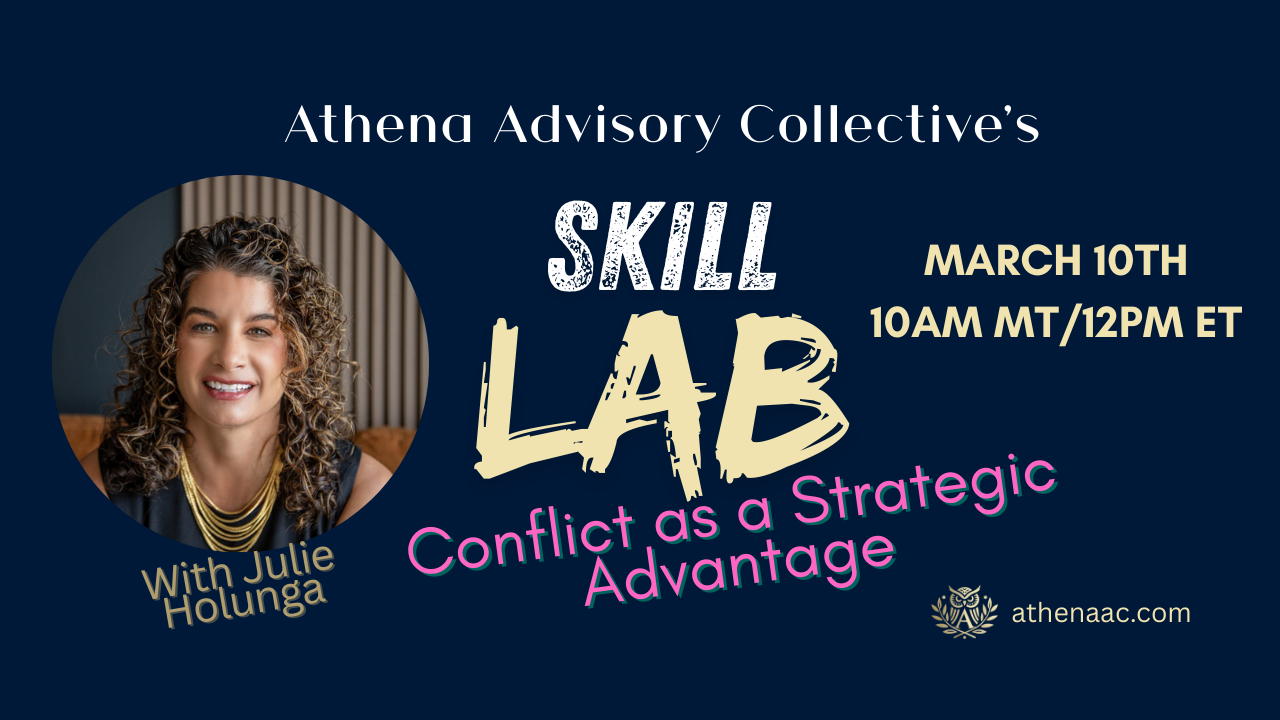
March 10 Skill Lab with Julie Holunga
At our March Skill Lab, we tackled a topic that shows up everywhere in business and leadership: conflict.
Joined by leadership expert Julie Holunga, we had an honest and practical conversation about difficult conversations, conflict avoidance, and what it really takes to lead through discomfort instead of around it.
Julie challenged the idea that conflict is something to fear or avoid. Her message was clear:
Conflict is not the problem. Avoidance is.
Conflict is not only unavoidable, it is necessary for innovation, clarity, and problem solving. The real cost comes when leaders choose comfort over clarity. That is where teams lose time, energy, trust, and momentum.
The Conflict Avoidance Tax
One of the most powerful ideas from the session was Julie’s concept of the Conflict Avoidance Tax.
This is the hidden cost leaders and business owners pay when they delay hard conversations, soften expectations, or hope problems will solve themselves.
Avoidance may feel easier in the moment, but over time it creates drag, frustration, and wasted energy across teams and organizations.
Julie shared research showing that almost one-third of workplace time is lost due to poorly handled conflict.
That is a significant leadership and productivity cost.
The Three C’s of Conflict Competence
Julie introduced a framework for building conflict competence, centered around three key areas:
1. Clarity
The first step is understanding how you naturally respond to conflict.
Julie shared three common conflict types:
Avoider
The person who would rather not deal with the issue and hopes it goes away.
Overanalyzer
The person who replays conversations, overthinks possible reactions, and spends energy trying to predict outcomes.
Instigator
The person who pushes conflict forward quickly, often trying to force movement or action.
Many participants realized their style can change depending on the situation, the relationship, or whether the conflict is personal or professional.
2. Choice
When conflict begins to surface, leaders have a choice.
They can move down a destructive path or a constructive path.
Destructive path behaviors include:
Focusing on the person instead of the problem
Trying to prove you are right
Reacting emotionally
Avoiding the conversation entirely
Constructive path behaviors include:
Focusing on the issue or task
Exchanging ideas
Seeking understanding
Working toward a solution together
The goal is not to eliminate frustration. It is to stay focused on the problem, not attack the person.
3. Communication
The third piece is communicating in a way that builds trust rather than defensiveness.
Julie emphasized the importance of practicing curiosity over judgment.
Instead of making assumptions about behavior or intent, leaders should ask better questions.
One of the most powerful questions she shared was:
“What is the real challenge here for you?”
That small shift lowers defensiveness and opens the door to a more honest conversation.
The Intent–Impact Gap
Julie also explained a common source of workplace conflict: the intent–impact gap.
We judge our own communication by our intentions, while others judge it by the impact it has on them.
Many misunderstandings happen because leaders assume their intentions are clear, but the message lands differently for the other person.
Closing that gap requires clarity, curiosity, and stronger communication.
A Reminder for Remote Teams
Another practical reminder from the session:
Do not have hard conversations over email, text, or Slack.
Written communication can easily be misinterpreted and often increases conflict rather than resolving it. Difficult conversations should happen live whenever possible.
A Framework for Difficult Conversations
Julie also shared a six-part approach to navigating conflict when the other person is defensive or resistant.
Leaders should:
Define the goal of the conversation
Engage curiosity
Reflect on their own role in the situation
Involve the right allies or advisors if needed
Prepare for possible pushback
Evaluate what worked and adjust for the future
This framework encourages leaders to slow down and approach difficult conversations deliberately.
Leadership is Communication
One theme that emerged from the group discussion was accountability.
Many leaders assume expectations are obvious. Often they are not.
In many situations, what appears to be a performance issue is actually a clarity issue. Clear expectations, communication, and follow-up are essential for creating accountability.
The Titanium Rule™
Julie closed the session with one final leadership principle:
The Titanium Rule™: Speak to others the way they want and need to be spoken to.
This builds on the well-known Golden and Platinum Rules and challenges leaders to adapt their communication style to what others need to hear in order to understand and act.
Leadership is not about avoiding discomfort.
It is about creating clarity, building trust, and having the conversations that move people and businesses forward.
Thank You
A big thank you to Julie Holunga for leading this thoughtful and practical conversation.
Upcoming Events
Next Skill Lab
April 7 | 10:00 AM
Topic: Leverage Your Certification
Women of Influence Dinner
April 8 6:00 PM - 9:00 PM | Indulge Wine Bistro, Golden, CO
More details and invitations will be shared soon.
