
Exit Readiness: How to Build a Business Buyers Can Trust
Many business owners spend years building their companies but wait too long to think seriously about what comes next.
Whether the goal is to sell, transition to a family member or key employee, bring in a partner, or simply create more freedom as the owner, exit readiness matters long before a transaction is on the table.
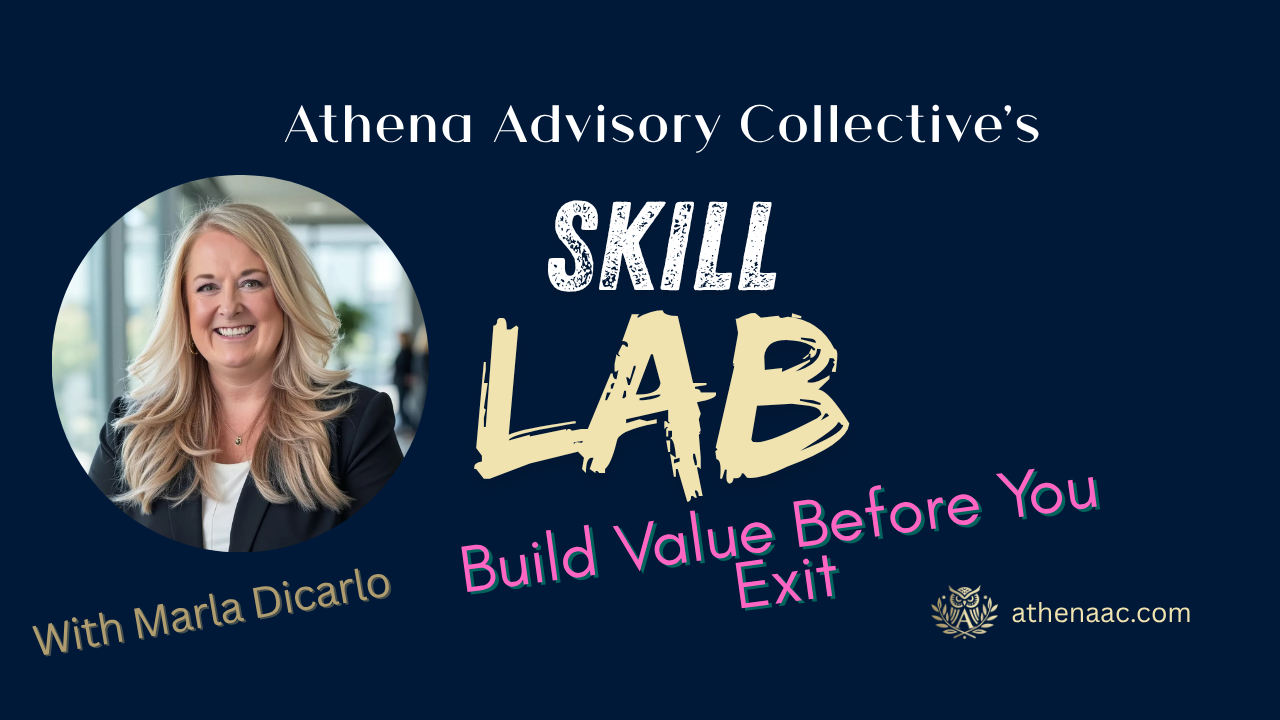
In our latest Athena Skill Lab, Marla DiCarlo, Owner & CEO of BizNavigators, led a practical conversation on what business owners should be thinking about before exiting their business. The session focused on how to build a stronger, more valuable, and more transferable company.
Marla also provided a fillable workbook to accompany the session. We recommend downloading the workbook before watching the recording so you can work through the exercises as you listen. The workbook will help you assess your own exit readiness, identify value gaps, and create a focused 90-day action plan for your business.
The key message was simple: exit readiness is not just about selling your business. It is about building a business that can operate, grow, and hold value without the owner being at the center of everything.
The Strategic Overview
A strong exit starts before the owner is ready to leave.
Marla encouraged business owners to look at their companies through the same lens a buyer, lender, or investor would use. Buyers are not only looking at past performance. They are trying to understand whether the business can continue producing reliable cash flow after the owner steps away.
That means owners need to focus on three key areas:
Transferability
Financeability
Defensibility
In other words:
Can the business run without the owner?
Can the financials support the value?
Can the business protect its future revenue and market position?
The more confidence a buyer has in those areas, the stronger the business becomes.
Core Lever 1: Clarify the Owner’s Exit Goals
Before thinking about valuation, deal structure, or buyer interest, owners need to get clear on what they actually want from an exit.
Marla walked participants through four important questions:
When would you ideally like to step back or exit?
Do you want to leave completely, stay involved, consult, or transition slowly?
What does the exit need to fund or protect?
What matters beyond price, such as employees, customers, family, brand, or legacy?
This matters because a successful exit is not only about the offer. It is about whether the transaction supports the owner’s personal, financial, and legacy goals.
Growth and Exit Lens
Clarity around the owner’s goals directly affects buyer fit, timing, deal structure, and transition planning.
For example, an owner who wants to exit quickly may need cleaner financials, stronger systems, and more realistic expectations around value. An owner who wants to preserve legacy may need to focus as much on the right buyer as the highest price.
A business is easier to position when the owner knows what a successful outcome actually looks like.
Core Lever 2: Build Financial Credibility
One of the strongest themes from the session was that buyers do not just look at cash flow. They look at the quality, consistency, and proof behind the cash flow.
Buyers want to know:
Can the earnings be verified?
Do the tax returns, profit and loss statements, balance sheet, and bank activity align?
Are add backs reasonable and well documented?
Are working capital needs clear?
Are revenue and profit trends explainable?
Messy financials create doubt. Doubt creates risk. Risk can lower the purchase price, slow down due diligence, or lead to more seller financing or earn outs.
Growth and Exit Lens
Clean financials increase buyer confidence. They also help business owners make better decisions while they are still running the company.
When the numbers are clear, owners can better understand profitability, cash flow, growth opportunities, and weak spots. For a future buyer, strong financial credibility helps support the value of the business and reduces friction during the sale process.
This is one of the most important areas to strengthen before a business ever goes to market.
Core Lever 3: Reduce Owner Dependency
Owner dependency is one of the biggest risks in a sale.
If the owner holds the key customer relationships, makes most of the decisions, manages the team, solves the problems, and keeps the knowledge in their head, the business becomes harder to transfer.
Marla asked owners to consider this question:
What would break, slow down, or become confusing if you stepped away for 30 days?
That question helps reveal where the business depends too heavily on one person, one customer, one vendor, one employee, or one undocumented process.
Growth and Exit Lens
Reducing owner dependency increases enterprise value because it shows that the business can continue without the owner’s daily involvement.
This may include:
Documenting key processes
Delegating owner-held responsibilities
Cross-training team members
Transferring customer relationships
Creating backup vendor options
Building stronger management depth
A business that can run without the owner is not only more sellable. It is also easier to scale.
Core Lever 4: Improve Revenue Quality
Not all revenue is valued the same way.
Marla explained that buyers look at revenue based on how predictable, transferable, and dependable it is.
Recurring revenue is usually the most attractive because it is contracted, subscription-based, retained, maintenance-based, or otherwise predictable.
Repeat revenue is also valuable, but buyers may ask more questions because customers must choose to come back each time.
Project-based revenue can still support a strong business, but it is often viewed as less predictable because it depends on the next sale, referral, bid, or owner relationship.
Growth and Exit Lens
Predictable revenue reduces buyer risk and increases confidence in future cash flow.
Business owners can strengthen revenue quality by looking for ways to create recurring revenue, improve retention, document customer loyalty, renew contracts, track referral sources, and reduce reliance on owner-driven sales.
The stronger and more transferable the revenue story, the more confidence a buyer can have in the future of the business.
Core Lever 5: Create a Defensible Growth Story
Buyers want to understand why the business will continue to win.
That means owners need to clearly explain what makes the business different, valuable, and hard to copy.
Marla introduced the idea of a “moat sentence.” This is a clear statement that explains:
Who the business serves
What outcome it helps them achieve
What unique capability creates that outcome
Why competitors cannot easily copy it
A generic statement like “we provide great service” is not enough. Buyers want proof.
Growth and Exit Lens
A clear growth story helps a buyer understand the upside.
It shows why customers choose the business, why they stay, and why the company has room to grow. This can make the business more attractive to buyers, lenders, and investors because it connects past performance to future opportunity.
A strong moat is not just marketing language. It is part of the value story.
What Buyers Will Ask For
Marla also walked through the three major areas buyers will evaluate during due diligence.
Financial Package
Buyers may ask for:
Three years of tax returns
Year-to-date profit and loss statement
Balance sheet
Add back support and schedules
Working capital needs
Debt summary
Forecast or budget
Operational Proof
Buyers may want to see:
Org chart
Roles and responsibilities
SOPs and key systems
Customer and vendor data
Contracts and leases
Top customer concentration
Key metrics and KPIs
Transition Story
Buyers will want to understand:
The owner’s current role
Management depth
Training and onboarding plan
Knowledge transfer plan
Growth initiatives
Pipeline
Cultural continuity
The cleaner the story and the stronger the supporting evidence, the fewer surprises during due diligence.
The 3-Step Athena Action Plan
Exit readiness can feel overwhelming, but it does not need to start with 20 projects.
Start with three focused actions.
1. Fix One Financial Proof Gap
Choose one area that would be hard to explain to a buyer today.
That might include documenting add backs, reconciling financial statements, organizing tax returns, clarifying working capital needs, or cleaning up reporting.
2. Reduce One Dependency
Identify one process, relationship, vendor, customer, or decision that depends too heavily on the owner or one key person.
Then take one step to reduce that risk. Document the process, delegate the task, cross-train a team member, or create a backup plan.
3. Strengthen One Revenue or Growth Story
Pick one way to make future revenue easier to believe.
That could mean renewing a contract, improving retention, tracking referrals, documenting customer demand, building a pipeline report, or clarifying the next growth opportunity.
Small steps create value when they are focused and consistent.
Lastly…
Exit readiness is not a one-time event. It is an ongoing value-building process.
Even if a sale is years away, the same work that prepares a business for exit also makes it stronger today. Cleaner financials, stronger systems, reduced owner dependency, better revenue quality, and a clearer growth story all help create a business with more options.
The goal is not to push every owner toward a sale.
The goal is to help owners build businesses that are more valuable, more transferable, and less dependent on them.
That is what creates freedom. That is what creates buyer confidence. And that is what protects the value business owners have worked so hard to build.
